Custom Search


By using digital loop control to implement power conversion products, you can realize many benefits for your design and business, including the ability to perform the power conversion control via reprogrammable software with the performance and features of the Microchip Digital Signal Controller (DSC) solutions.


Benefits of the dsPIC® DSC for SMPS and Digital Power Conversion Devices

The benefits of the dsPIC DSCs for Switch Mode Power Supplies (SMPS) and digital power conversion applications are many. The dsPIC30F1010 and dsPIC30F2020/2023 DSCs are self-contained SMPS solutions that do not require much in the way of external support chips, since they have the necessary peripherals to do the job. As opposed to other solutions, Microchip’s SMPS and digital power conversion devices have the following features, and therefore require fewer external components:

  • Internal power supply PWM
  • Internal ADC
  • Internal precision oscillator
  • Internal communication peripherals
  • Single supply voltage
  • Internal Flash and RAM
  • Small size
  • Extended temperature
  • No separate chip for power factor correction

When using the dsPIC DSC for SMPS and digital power conversion applications, developers can obtain a 50% reduction in component count over other solutions.

FEATURES
  • Increased power density
    • Reduce system size via component count and size reduction
    • Smaller magnetics via advanced switching techniques
  • Lower cost, improved time to market and ease of manufacturing
    • Feature rich designs with fewer components
    • Fewer hardware platforms support varied end products through software
  • New cost effective features
    • Dynamically adapt to changing load
    • Better transient response specifications – not limited to linear techniques
    • Managed voltage transitions eliminate “over-specified” components
  • Improved reliability
    • Supplies can be restricted from operating out of specification
    • Fewer components help reliability
  • Protect intellectual property
    • Key innovative IP implemented in secured Flash software
APPLICATIONS
  • AC-to-DC converters
  • DC-to-DC converters
  • Power Factor Correction (PFC)
  • Uninterruptible Power Supply (UPS)
  • Inverters
  • Embedded power supply controllers
  • Circuit breakers, arc fault detection
  • Digital lighting

Controlling Your Power

dsPICDEM SMPS Buck Development Board

This development board provides an easy and economical way to evaluate the dsPIC30F202x/1010 SMPS and Digital Power Conversion family of components and provides an educational and prototyping platform to investigate digital power conversion and digital Switch Mode Power Supply (SMPS) design. The board includes a socketed dsPIC30F2020 device connected to power devices and circuitry for controlling dual independent low power DC-to-DC Synchronous Buck Converter circuits as well as support, debug and communication circuitry.


DM300023 Buck Development Board

Board Includes

  • Socketed dsPIC30F2020 on board connected to power devices and circuitry for controlling dual independent low power DC-to-DC synchronous buck converter circuits
  • Buck converters can operate in synchronous or asynchronous modes
  • Input voltage range 7V to 15V (nominal 9V)
  • User can enable a dynamic output load to investigate transient response
  • User potentiometers to simulate application features such as voltage trim, remote voltage sense, voltage tracking, current sharing, etc.
  • MPLAB® ICD 2 or REAL ICE support ready
  • RS-232 serial channel
  • Example software for implementing digital dual synchronous buck converter

Package Contents

  • dsPICDEM SMPS Buck development board
  • Example software, educational material and documentation on CD

Minimum Requirements

  • MPLAB IDE v7.42 or later
  • MPLAB ICD 2
  • MPLAB C30 v2.03 or later
  • dsPICDEMTM SMPS Buck development board

dsPICDEM 28-Pin Starter Development Board

The low cost dsPICDEM 28-pin starter demonstration board allows the user to easily validate a development tool setup using a 28-pin SDIP or SOIC dsPIC30F device. The demonstration board has a socketed dsPIC30F2010 digital signal controller, power supply regulator, crystal oscillator, ICD header, serial port, power on indicator, reset push-button, 28L SOIC layout pad and a prototyping area.


Oil Reserves

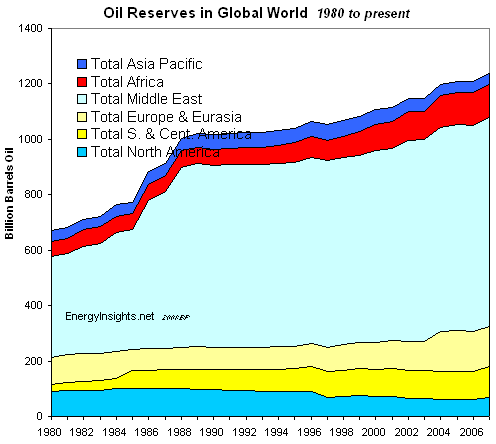
Global Oil Reserves Per Region - since 1980
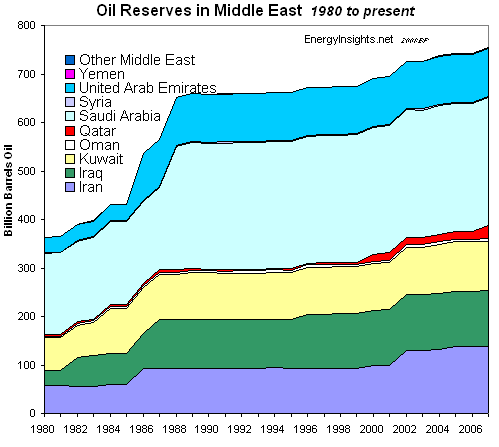
Oil Reserves Middle East region - since 1980
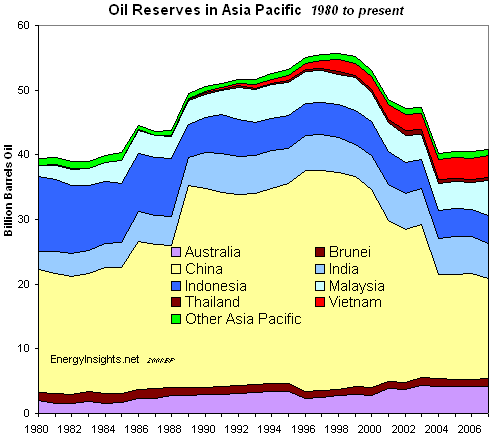
Oil Reserves Asia Pacific region - since 1980
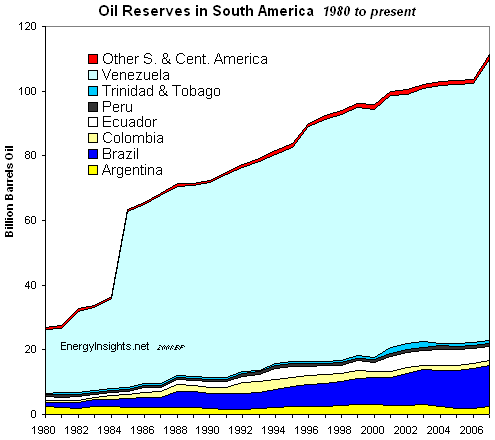
Oil Reserves South America region - since 1980
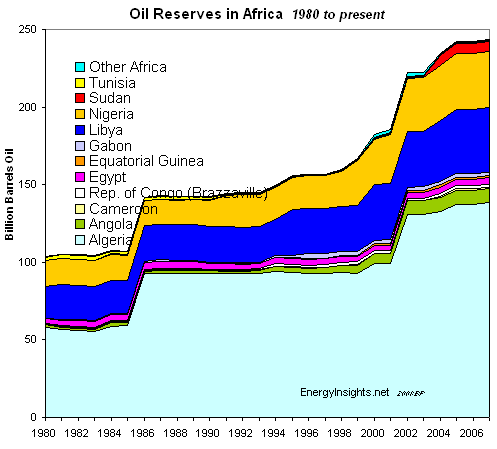
Oil Reserves Africa region - since 1980
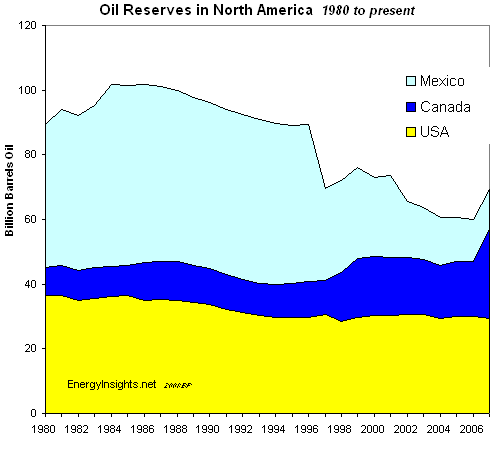
Oil Reserves North America region - since 1980
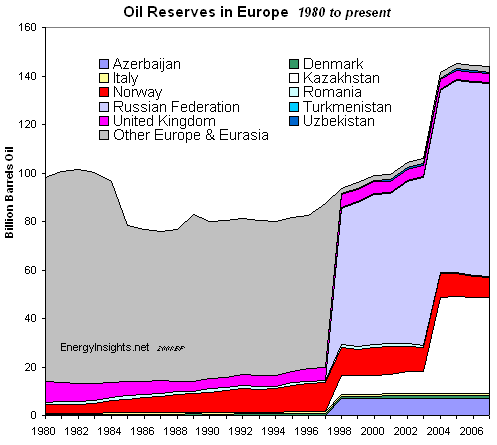
Oil Reserves Europe region (including Russia) - since 1980
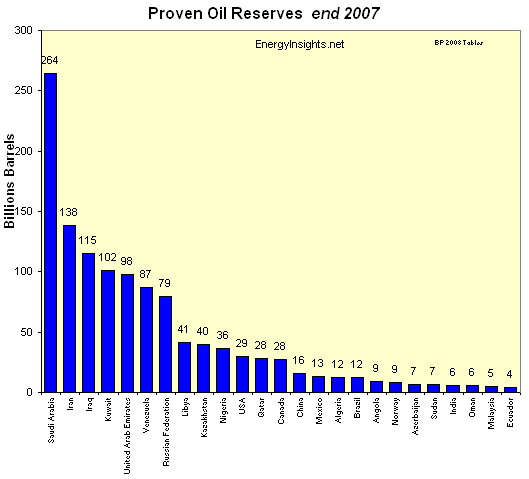
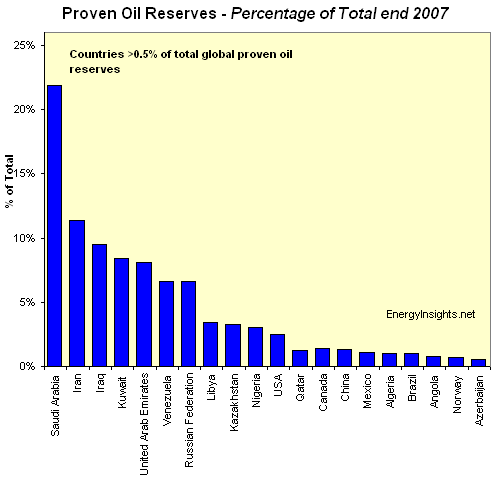
Proven Oil Reserves - in major countries by reserves size at end 2007
Proven Reserves - major countries (top 20) by reserves size
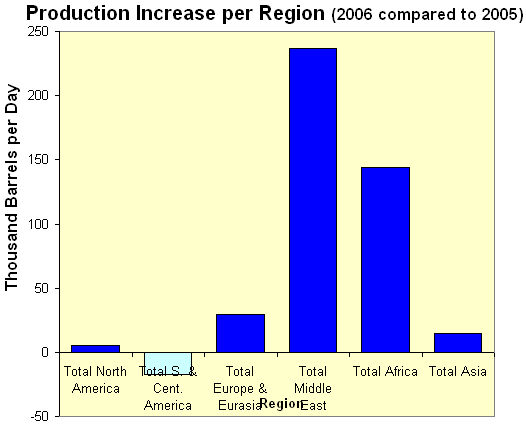
Oil Production Increase - per region in 2006 compared to 2005 - in barrels per day - note remarkable stability as a percentage when considering the total world oil prdoction of ca. 85 million barrels per day

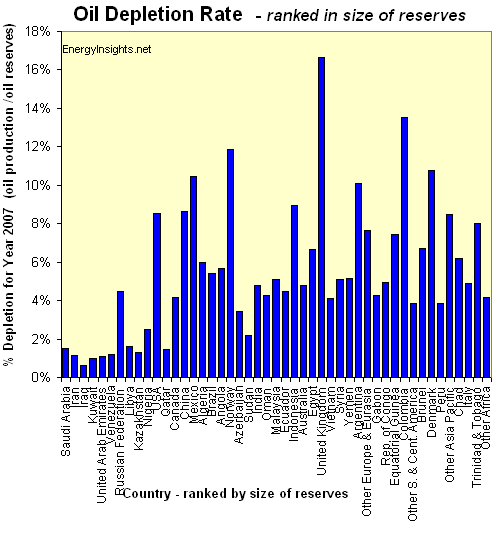
Oil Depletion Rates - ranked by size of reserves - the highest reserves are to the left and lowest to the right - in major countries by reserves countries - as of end 2007. UK has highest depletion rate of 17% with Saudi Arabia, Iran, Iraq and Kuwait the lowest at 1-2% per annum (implying ca. 50 to 100 years of production at current rates).
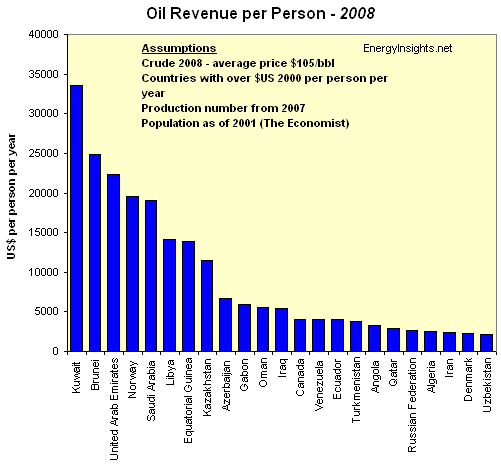
Oil Revenue Per Person per Country in 2008 - in major countries by reserves size. Note at ca. $105/bbl average in 2008, Kuwait delivered a sttaggering $33,500 per person. Brunei follws with $25,000 then UAE and Norway - at around $20,000 per person. These are some of the richest countries in the world if oil prices rise above ca. $50/bbl.
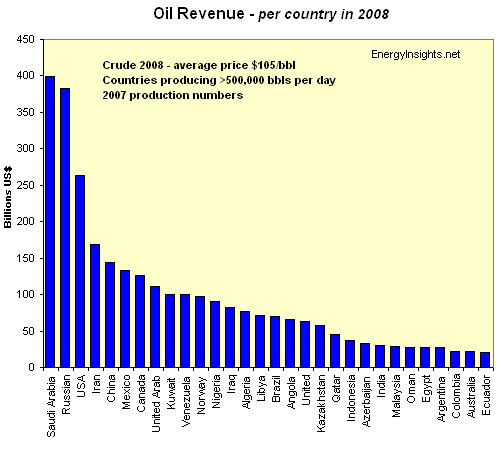
Oil Revenue per Country in 2008 - in major oil producing countries. Note Saudi Arabia and Russia head the list with production at ca. 9.5 million barrels a day. Both countries export most of their oil. USA is third but is a large net importer of ca. 8 million barrels a day.
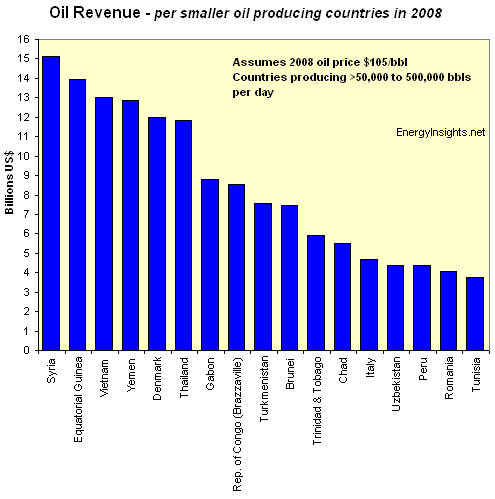
Oil Revenue per Smaller Oil Producting Country in 2008 - in major oil producing countries (note: gross produced revenue, not net or net exported revenue or profit). Based on 2008 oil price and 2007 oil production.
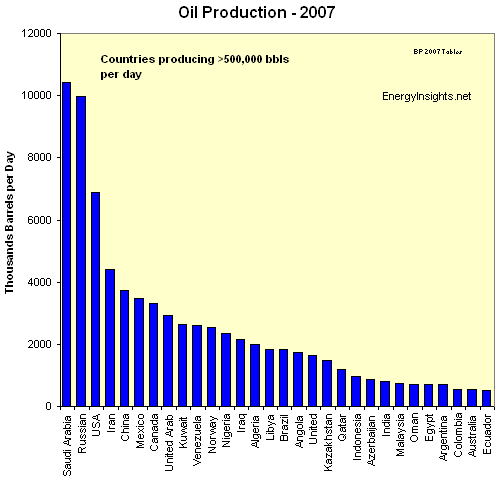
Oil Production per Country in 2007 - in major oil producing countries. Note Russia and Saudi Arabia are the biggest oil producers. Followed by USA. However, USA importa ca. 8 million barrels a day, whilst Saudi exports the bulk of it's oil.
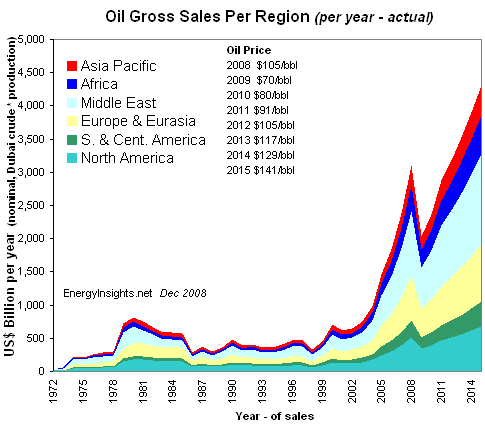
Gross Oil Sales Per Region - 1972 to present, and forecast to 2015 based on the below oil price forecast. This chart shows the total region's oil production multiplied by the average oil price in that year (benchmarked to Dubai price). Note - the price forecast is uncertain, but with prices crashing from $147/bbl to $33/bbl from July 2008 to Dec 2008, we expect prices to recover as the recession ends - thence tightening of supply and increase in demand to drive up prices end 2009.
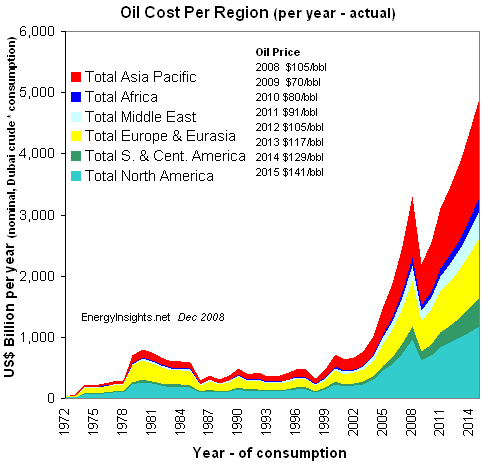
Cost of Oil Per Region - 1972 to present, and forecast to 2015 based on the below oil price forecast. This chart shows the total region's oil cost - this is the oil consumption multiplied by the average oil price in that year (benchmarked to Dubai price). Note - the price forecast is uncertain, but with prices crashing from $147/bbl to $33/bbl from July 2008 to Dec 2008, we expect prices to recover as the recession ends - thence tightening of supply and increase in demand to drive up prices end 2009.
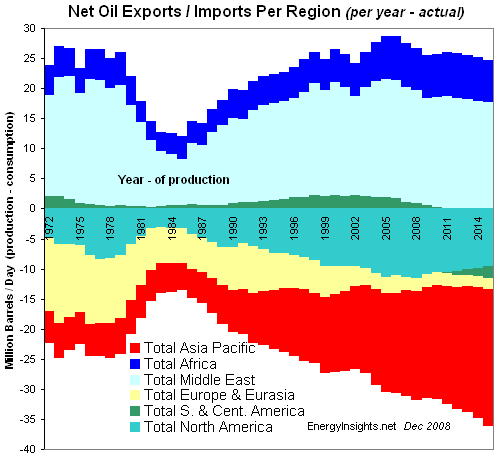
Net Oil Exports and Imports Per Region - 1972 to present, and forecast to 2015. Note the massive Fast Eastern draw on oil in years to come. Europe region is only slightly negative only because Russia is added into this region. Middle East are the clear exporters - with Africa another net exporter (85% from Libya, Algeria, Nigeria and Angola).
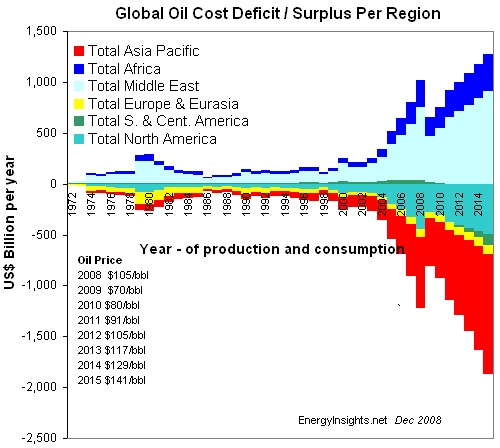
Global Oil Cost Deficits and Surplus Per Region - 1972 to present, and forecast to 2015. Using historical oil prices before end 2008, and oil price forecast below up until 2015. Note recession impacts 2009 and 2010 - as Middle East cuts back oil and the oil price crashes, before recovering end of decade.
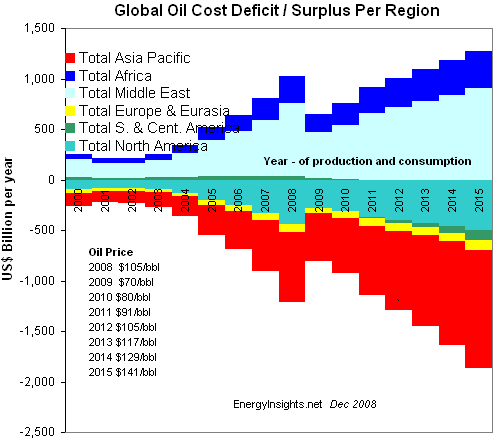
Global Oil Cost Deficits and Surplus Per Region - 2000 to present, and forecast to 2015. Using historical oil prices before end 2008, and oil price forecast below up until 2015. Note recession impacts 2009 and 2010 - as Middle East cuts back oil and the oil price crashes, before recovering end of decade.

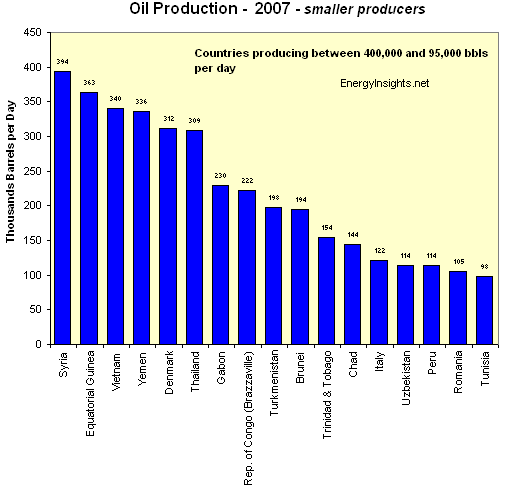
Oil Producing in Smaller Producing Country in 2007

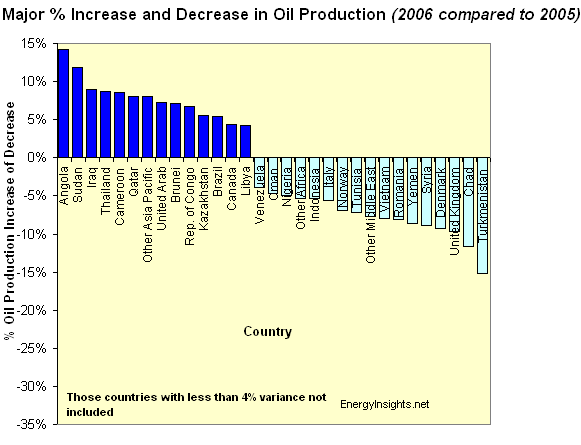
Oil Production - Major Percentage Increase and decrease - 2006 compared to 2005. Note Angola is the world biggest % increaser in oil production. This is likely to continue in 2008 and possible 2009. Chad is in decline as is UK and Turkmenistan - this is also likely to continue in 2008 and 2009. However, OPEC (mainly Middle Eastern) countries will cut back production end 2008 and early 2009.

Vicious Viruses or Artifficial Intelligence


 Our computers were stricken by one of the most vicious and ingenious strain of virus/malware/Trojan system I have ever seen. It was a multi stage and multi component system composed of a timer based installer, a downloader that contains another downloader that in turn installs viruses that install other viruses. In addition this system operates in worm mode and installs itself on any other computer in the network exploiting the latest zero day security holes. In addition it uninstalls the antivirus on the computer and disables the firewall and the automatic updates, and preventing the installation of antiviruses. Because of the way it works the antivirus software took close to four days to discovers all the hidden features, slipping back between safe mode, offline updates and other methods of removing the virus. I am still unsure that it is behind me.

One of the most logical question would be: What do these operators and programmers stand to gain from designing a system on such a huge scale? The surprising answer is hundreds of millions of dollars, perhaps even billions! Over the last few years I have been working alongside with some of the major Internet marketing experts, which gave me insight to the problem. One of the key components in any successful internet marketing strategy is affiliate programs. These programs allow the vendor to expand the services to customers and add value to the site.

As an example, suppose we have a website that helps people find movers in their area. suppose you visit the above site and click on boxes. The boxes are supplied by a third party. Most affiliate programs have a vendor ID that is assigned to the link and a cookie to help track that the user indeed was referred by the vendor. This allows the user to leave the site. If on a subsequent visit the user decides to buy a product or service, the vendor would be granted a percentage of the sale. It use to be common practice to install a frame called a "invisible popup" in the page to mark the client and pay money to perpetrators, but newer browsers block these attempts.

I think you now all understand why these malware/viruses are such a lucrative business. By opening up as many sites as possible before being removed you are actually tagging these sites so if you purchase from any of these sites within three months you are paying the pirates a large percentage of the sale. For example if a Trojan popped up Amazon, then every purchase will pocket at least 4% of the profits (see this for example)

A couple of years ago I turned down a very high paying job offer to develop such malware for a company that makes well over 100M in profits every year from this scam. This is only one in a list of hundreds of companies worldwide that exist to exploit these security problems.

Unlike battling pirates in a million square mile area, government can battle the virus operators by the racketeering laws to follow the money trail and shut these operations down. They can investigate and expose the operators by infecting computers with the viruses and see what affiliate programs are tagged. Then they can hold payments by the affiliate programs. I think that these measures would be far more effective that trying to nail a specific individual. By drying up the pond, you get rid of the mosquitoes.

It would appear that I am in the business of making viruses - that is not the case - I went to a job interview and when I did a background check of what the company does that is what I discovered. I decided that morally I cant be associated with such a company

GM, DaimlerChrysler, BMW Premiere Unprecedented Hybrid Technology


The state-of-the-art full hybrid system, whose components are being co-developed by General Motors Corp., DaimlerChrysler and the BMW Group for production beginning next year, represents a major automotive industry milestone due to the unprecedented fully integrated combination of electric motors with a fixed-gear transmission.

As a result of its low- and high-speed electric continuously variable transmission (ECVT) modes, the system is commonly referred to as the 2-mode hybrid. However, the sophisticated fuel-saving system also incorporates four fixed gear ratios for high efficiency and power-handling capabilities in a broad variety of vehicle applications. During the two ECVT modes and four fixed gear operations, the hybrid system can use the electric motors for boosting and regenerative braking.

In summary, the four fixed gears overlay two ECVT modes for a total of six operating functions:

  • Input-split ECVT mode, or continuously variable Mode 1, operates from vehicle launch through the second fixed gear ratio.
  • Compound-split ECVT mode, or continuously variable Mode 2, operates after the second fixed gear ratio.
  • First fixed-gear ratio with both electric motors available to boost the internal combustion engine or capture and store energy from regenerative braking, deceleration and coasting.
  • Second fixed-gear ratio with one electric motor available for boost/braking,
  • Third fixed-gear ratio with two electric motors available for boost/braking.
  • Fourth fixed-gear ratio with one electric motor available for boost/braking.

The result is trend-setting hybrid technology that provides superior fuel economy, performance and load carrying capability.

The full hybrid system being co-developed by General Motors, DaimlerChrysler and the BMW Group has an overall mechanical content and size similar to a conventional automatic transmission, yet this full hybrid transmission can operate in infinitely variable gear ratios or one of the four fixed-gear ratios.

A sophisticated electronic control module constantly optimizes the entire hybrid powertrain system to select the most efficient operation point for the power level demanded by the driver.

Key Advantages

When compared to conventional hybrid systems, this avant-garde hybrid technology, relying on both the ECVT modes and the four fixed gear ratios, provides advantages in combined (city and highway) fuel economy, dynamics and towing capability.

Traditional hybrid systems typically have only one torque-splitting arrangement and no fixed mechanical ratios. These systems are often called “one-mode” hybrids. Due to their less capable mechanical content, one-mode hybrids need to transmit a significant amount of power through an electrical path that is 20 percent less efficient than a mechanical path. This requires usually substantial compromise in vehicle capability or reliance on larger electrical motors, which can create cost, weight and packaging issues.

General Motors, DaimlerChrysler and the BMW Group have conceived a full hybrid system featuring four fixed mechanical ratios, within the two ECVT modes, to reduce power transmission through the less efficient electrical path. Consequently, the electric motors are more compact and less dependent on engine size.

This combination of two ECVT modes and four fixed gear ratios eliminates the drawbacks of one-mode hybrid systems to allow for efficient operation throughout a vehicle’s operating range, at low and high speeds. It also allows for application across a broader variety of vehicles. It is particularly beneficial in demanding applications that require larger engines, such as towing, hill climbing or carrying heavy loads.

Existing internal combustion engines can be used with relatively minimal alteration because the full hybrid system imposes no significant limitation on the size or type of engine. It enables the three global automakers to package internal combustion engines with the full hybrid transmissions more cost-effectively and offer the fuel-saving technology across a wider range of vehicles.

Initial applications are suitable for front-engine, rear- and four-wheel-drive vehicle architectures, but the full hybrid system has the flexibility to be used in front-engine, front-wheel-drive architectures in the future as well.

Global Hybrid Cooperation

General Motors, DaimlerChrysler and the BMW Group have formed a cooperative effort called the Global Hybrid Cooperation, which is actively developing this next generation hybrid powertrain system. In an alliance of equals, all three partners are pooling expertise and resources to jointly and efficiently develop hybrid technology. Each company will individually integrate the full hybrid system into the design and manufacturing of vehicles in accordance with their brand specific requirements.

In Troy, Michigan, the “GM, DaimlerChrysler and BMW Hybrid Development Center” houses together engineers and specialists from all three companies to develop the complete hybrid system and the individual components -- electric motors, high-performance electronics, wiring, energy management, and hybrid system control units. In addition, the “GM, DaimlerChrysler and BMW Hybrid Development Center” will be responsible for system integration and project management.

A key factor in ensuring optimum development is the focus on a flexible system design that can be scaled to the size, mass and performance needs of the various vehicle concepts and brands. The extensive sharing of components and the collaborative relationship with suppliers will enable the alliance partners to achieve economies of scale and associated cost advantages that will also benefit customers. Currently full hybrid systems are under development for front- and rear-wheel-drive passenger cars, and light-duty truck and SUV applications.

General Motors Corp. , the world’s largest automaker, has been the global industry sales leader for 75 years. Founded in 1908, GM today employs about 327,000 people around the world. With global headquarters in Detroit, GM manufactures its cars and trucks in 33 countries. In 2005, 9.17 million GM cars and trucks were sold globally under the following brands: Buick, Cadillac, Chevrolet, GMC, GM Daewoo, Holden, HUMMER, Opel, Pontiac, Saab, Saturn and Vauxhall. GM operates one of the world’s leading finance companies, GMAC Financial Services, which offers automotive, residential and commercial financing and insurance. GM’s OnStar subsidiary is the industry leader in vehicle safety, security and information services. More information on GM can be found at www.gm.com.

DaimlerChrysler’s product portfolio ranges from small cars to sports cars and luxury sedans; and from versatile vans to heavy duty trucks or comfortable coaches. DaimlerChrysler’s passenger car brands include Maybach, Mercedes-Benz, Chrysler, Jeep®, Dodge and smart. Commercial vehicle brands include Mercedes-Benz, Freightliner, Sterling, Western Star, Setra, Mitsubishi Fuso, Thomas Built Buses and Orion. DaimlerChrysler’s strategy rests on four pillars: Excellent products offering outstanding customer value, leading brands, innovations and technology leadership and global presence and networking. With 382,724 employees, DaimlerChrysler achieved revenues of €149.8 billion in 2005.

The BMW Group covers the BMW, MINI and Rolls-Royce brands. The BMW Group is the only automobile company worldwide to operate with all its brands exclusively in the premium segments of the automobile market, from the small car to the absolute top segment. The BMW Group's vehicles provide outstanding product substance in terms of aesthetic design, dynamic performance, cutting-edge technology and quality, underlining the company's leadership in technology and innovation. Today, with revenues of 46.7 billion euro, annual sales of 1.328 million automobiles (thereof 200,000 MINIs), 97,500 BMW motorcycles and with almost 106,000 associates, the BMW Group is one of the world's ten largest automobile manufacturers.

America’s fastest train moves ahead Funding boost propels maglev, which still faces headwinds

Image: Maglev
General Atomics
The magnetic levitating train, or "maglev," can travel at up to 310 mph, and could compete with commercial airplanes, which cruise at about 550 mph.


a
Could America’s fastest train whisk us away from $4-a-gallon gas guzzlers?

Thanks to a $45 million infusion from a transportation bill signed by President Bush in early June, there could someday be a magnetic levitating train, or “maglev,” soaring from Disneyland to Las Vegas at a maximum speed of 310 mph — 180 mph on average.

After the research phase is complete in about three years, the private partnership behind the effort, American Magline Group, comes to its biggest crossroads: obtaining $12 billion in funding for construction.

“If we had the money tomorrow, we’d build it in five years,” he said.

What’s slowing down America’s fastest train, however, is the hefty cost of crafting the infrastructure — including the guideway — from scratch, because the fastest train can’t run on ordinary steel tracks. The $45 million from the federal government will only cover pre-construction obligations, including environmental testing in the Mojave Desert, where the line would be laid.

But as spiking gas prices and traffic pinch both nerves and wallets, and flight costs and delays hamper air travel, the maglev joins the list of alternatives to the nation’s transportation tribulations.

“With our gasoline prices and everything else going on, people and government are ready to make a commitment,” Cummings said. Until now, “we haven’t committed to high-speed trains in this country — at all.”

America’s fastest train could compete with air travel. Flying from Anaheim, Calif., to Vegas on a passenger jet cruising at about 550 mph can cost upward of $150, while a ticket for the same route on a maglev would cost $55, according to the American Magline Group.

Plus, the maglev doesn’t pollute. It’s energy efficient. And it's low-maintenance because the train levitates — thanks to magnets — avoiding wear-and-tear on the underlying “guideway.” That’s what propels the vehicle through a magnetic field established by the electrical grid. Upping the current accelerates the train. Lowering the current slows the train. And reversing the current stops or pushes the train backwards.

Paul Saffo, a Silicon Valley technology forecaster, said the lure of Las Vegas might just be what it takes to turn a profit with the maglev. The world’s first maglev, a 19-mile line in Shanghai, China, doesn’t garner enough traffic to offset the initial investment. But there are plans to extend the route, with hopes of attracting enough riders to reach critical mass.

While the California-Nevada maglev has scored the most federal funding to date, two other lines, from Pittsburgh International Airport to downtown and from Baltimore to D.C., are also competing for federal dollars for construction.

The two East Coast lines make sense to many, and Cummings of the American Magline Group said the Disneyland-to-Vegas line is more than what critics have dismissed it as: a “gamblers’ express.”

Is America's fastest train a practical solution for our transportation woes?

While the Western line aims to relieve traffic on the congested Interstate 15 highway which leads to “Sin City,” the first two segments, which would connect Las Vegas to Primm, Nev., and Orange County to Ontario, Calif., could shoot commuters to work and back home, he said.

“It’s an exciting alternative if you want to live in the suburbs, outside the main city,” Cummings said.

Not everyone is convinced a Maglev is a good idea. The Federal Railway Administration argues transportation dollars should aid America’s current public transportation system. The railway administration, which asked for $100 million in funding from the federal government, only received $30 million under the recent transportation bill.

“It’s great to have a train that goes 200 mph from Disneyland to Las Vegas, but that money could improve things in Los Angeles, Chicago, Miami, New York ... Seattle,” said FRA spokesman Steve Kulm.