Custom Search


Sony - PlayStation 3 review


Hardware reviews > Games console reviews > Sony PlayStation 3 

immensely powerful and hugely expensive new games console (26/03/2007)

To be fair to Sony, the actual hardware was never really going to be in much doubt. And after your first few hours in the company of the PlayStation 3, you're likely to be impressed.

Several initial thoughts went through this reviewer's head. Firstly, the machine's really quite heavy. Secondly, aesthetically, it's really quite smart. And thirdly, and surprisingly, is that given the immense processing grunt under its glossy, buffed-up exterior, it's very quiet in operation. It certainly puts the Xbox 360 in the shade in that department.

When we switched on for the first time, following as simple a connection procedure as you'd expect with a games console, we signed up for the PlayStation Network and downloaded an advised, albeit not compulsory, update. This involved us getting the machine online, which was thankfully straightforward. A built-in wireless receiver or the Ethernet port at the back are your two choices, and we tried both, finding the machine adapted to either at breakneck speed.

With the PlayStation 3's latest firmware update to version 1.8, Sony added in the long-awaited ability to upscale DVDs, PlayStation and PlayStation 2 games to HD resolutions. Each of 720p, 1080i and 1080p are supported on all accounts, though for DVDs you need an HDMI connection for those resolutions for copyright purposes. So with the new ability to play classic titles in HD resolutions, has Sony given these games a new lease on life, or at least their visuals?

We've put a number of PSone and PS2 games to the test. We went about capturing screens from each in a number of different settings so that you can compare them right here from the comfort of your computer. Hopefully it's cushioned... We captured everything at 1080p through equipment more expensive than many BMWs to simulate what these titles would look like on some of the best TVs available. And yes, that includes the games that aren't upscaled because HD sets would wind up scaling them internally anyway and it makes more sense to capture them like that rather than in Photoshop.

Our comparison shots have all been cropped in some way, but they've not been resized at all, which means you'll get a pixel-accurate look at the quality of the images. Our gallery images that you can use to compare the shots yourselves have only had a watermark and label thrown on them, but are otherwise untouched.

If you've played with the settings for this, you'll know that the PS3 offers options for the scaling of Off, Normal and Full. Normal means that the games will come out in a 4:3 resolution and Full means that everything will come out widescreen. So for our PSone titles we chose the Normal setting when upscaled while all our PS2 games were set to Full. The other option available has to do with smoothing, which we also tested out. And let it also be known that when titles that support progression scan have this option turned on, they revert back to 480p with no alterations. We've included some comparison shots to this as well.

IMPROVED SITUATIONAL AWARENESS AND OPTIMAL FLIGHT MANAGEMENT SOLUTIONS


Coordinating the effective use of airspace has always been a costly and complex operation, involving many stakeholders in
a variety of disciplines. Decisions made by a single individual ultimately impact other operations. The Lockheed Martin
Airline Solutions team offers products that provide improved situational awareness along with optimal flight management
and proven cost savings. These products are:

FltWinds™ System – which tracks all flights from initial flight plan filing through gate arrival at destination in real time
and provides dispatchers with alerts when their flights are
affected by inclement weather, air traffic control reroute,
delay or other flow management measures.
 
SPEAR™ Software – which enables airlines to analyze operational situations in near real time, and make operational decisions that improve on-time performance, meet customer service goals, and optimize overall operations.

FltWinds™ 2 Coming Soon! 


Integrated Air Situation Display


Proven Cost Benefits
Lockheed Martin’s FltWinds™ system augmented by SPEAR™ software is deployed at several international airlines, and in every case the combination has provided positive cash flow and a return on investment in less than one year.

Efficiency improvements, achieved through implementation of these innovative Lockheed Martin products, translate into immediate cost and carbon dioxide emission reductions for users as well as increases in productivity and customer satisfaction.

Strength through Teaming
In addition, Lockheed Martin offers comprehensive integrated airline operations solutions for air carrier efficiency by teaming with Flugwerkzeuge Aviation Software GmbH (f:wz) for 4-dimensional modular flight planning and a user-friendly, knowledge-based operations user system. Lockheed Martin also provides a full spectrum of graphical and textual weather products through its work with Meteostar, an Information Processing Systems business.

Integrated Airline Operations Suite Brochure
Integrated Airline Operations Suite Fact Sheet


Information Systems and Global Services
700 North Frederick Avenue
Gaithersburg, MD 20879
(301) 240-7500

CONTACT
Media and Press Inquiries: (301)640-3336
Business Development: (301)640-2266

The Artimis suite of airline software solutions is a series of turn key added value products. They have been designed with one thing in mind - to drive incremental revenue for airline frequent flyer programmes by combining the power of marketing with operational efficiency. 

Artimis software has been developed through hands-on global airline industry experience, stretching back to 1987. It is currently being used by a number of leading airlines to run their frequent flyer programmes and meet their long term strategic objectives.
Benefits include: 
Marketing solutions and enhancements for both existing and new programmes.
Highest level of security and integrity.
Intuitive navigation for all users.
Flexibility built-in to meet specific client requirements.
Quick to get up and running

Airline Reservations Software


From McCall Aviation website: 'McCall Aviation is an air charter company and fixed-base operator (FBO) based in central Idaho. With a fleet of fourteen airplanes, McCall Aviation specializes in charters to the backcountry and city-to-city flights throughout the intermountain West. The company operates two full service facilities (McCall and Salmon) along with seasonal operations in Stanley and a counter and gate in Boise that provide passenger services.'

In 2003 we were contracted to develop a flight booking and reservation software system for McCall Aviation located in Idaho. One of the most challenging aspects of the database was the requirement to generate flight manifests with point and click functionality. This feature included gathering passenger reservations and assigning to airplanes and then assigning pilots and co-pilots to the flights. 
We also create web-based reservations software for small airlines, charters and hotel reservations.


Airline reservations software key functions are:

Real time entry of flight reservations during telephone calls

Maintenance of returning customer database functions

Group reservation by date and time to dispatch fights

Assign pilots and plans to dispatched flights

Multi-leg flights with partial passenger list segment dropoff

Create various reports for process management

Below is a thumb nail of the airline reservations software data review screen. The reservation entry screen is similar, but optimized for fast data entry:


Aggregation of flights, assignment of pilots and plans are all handled on a multi-function screen which is highly optimized for this purpose. Note the moveable popup windows which keep tabs on pilot and plane assignments.


Thousands of reservations have been handled by this system with no degradation in performance.


A mini SABRE flight reservation system at one-millionth the cost.

What is Nanotechnology?


A basic definition: Nanotechnology is the engineering of functional systems at the molecular scale. This covers both current work and concepts that are more advanced.

In its original sense, 'nanotechnology' refers to the projected ability to construct items from the bottom up, using techniques and tools being developed today to make complete, high performance products.

The Meaning of Nanotechnology

When K. Eric Drexler (right) popularized the word 'nanotechnology' in the 1980's, he was talking about building machines on the scale of molecules, a few nanometers wide—motors, robot arms, and even whole computers, far smaller than a cell. Drexler spent the next ten years describing and analyzing these incredible devices, and responding to accusations of science fiction. Meanwhile, mundane technology was developing the ability to build simple structures on a molecular scale. As nanotechnology became an accepted concept, the meaning of the word shifted to encompass the simpler kinds of nanometer-scale technology. The U.S. National Nanotechnology Initiative was created to fund this kind of nanotech: their definition includes anything smaller than 100 nanometers with novel properties.

Much of the work being done today that carries the name 'nanotechnology' is not nanotechnology in the original meaning of the word. Nanotechnology, in its traditional sense, means building things from the bottom up, with atomic precision. This theoretical capability was envisioned as early as 1959 by the renowned physicist Richard Feynman.

I want to build a billion tiny factories, models of each other, which are manufacturing simultaneously. . . The principles of physics, as far as I can see, do not speak against the possibility of maneuvering things atom by atom. It is not an attempt to violate any laws; it is something, in principle, that can be done; but in practice, it has not been done because we are too big. — Richard Feynman, Nobel Prize winner in physics

Based on Feynman's vision of miniature factories using nanomachines to build complex products, advanced nanotechnology (sometimes referred to as molecular manufacturing) will make use of positionally-controlled mechanochemistry guided by molecular machine systems. Formulating a roadmap for development of this kind of nanotechnology is now an objective of a broadly based technology roadmap project led by Battelle (the manager of several U.S. National Laboratories) and the Foresight Nanotech Institute.

Shortly after this envisioned molecular machinery is created, it will result in a manufacturing revolution, probably causing severe disruption. It also has serious economic, social, environmental, and military implications.

Four Generations

Mihail (Mike) Roco of the U.S. National Nanotechnology Initiative has described four generations of nanotechnology development (see chart below). The current era, as Roco depicts it, is that of passive nanostructures, materials designed to perform one task. The second phase, which we are just entering, introduces active nanostructures for multitasking; for example, actuators, drug delivery devices, and sensors. The third generation is expected to begin emerging around 2010 and will feature nanosystems with thousands of interacting components. A few years after that, the first integrated nanosystems, functioning (according to Roco) much like a mammalian cell with hierarchical systems within systems, are expected to be developed.

Some experts may still insist that nanotechnology can refer to measurement or visualization at the scale of 1-100 nanometers, but a consensus seems to be forming around the idea (put forward by the NNI's Mike Roco) that control and restructuring of matter at the nanoscale is a necessary element. CRN's definition is a bit more precise than that, but as work progresses through the four generations of nanotechnology leading up to molecular nanosystems, which will include molecular manufacturing, we think it will become increasingly obvious that "engineering of functional systems at the molecular scale" is what nanotech is really all about.

Conflicting Definitions

Unfortunately, conflicting definitions of nanotechnology and blurry distinctions between significantly different fields have complicated the effort to understand the differences and develop sensible, effective policy.

The risks of today's nanoscale technologies (nanoparticle toxicity, etc.) cannot be treated the same as the risks of longer-term molecular manufacturing (economic disruption, unstable arms race, etc.). It is a mistake to put them together in one basket for policy consideration—each is important to address, but they offer different problems and will require different solutions. As used today, the term nanotechnology usually refers to a broad collection of mostly disconnected fields. Essentially, anything sufficiently small and interesting can be called nanotechnology. Much of it is harmless. For the rest, much of the harm is of familiar and limited quality. But as we will see, molecular manufacturing will bring unfamiliar risks and new classes of problems.

General-Purpose Technology

Nanotechnology is sometimes referred to as a general-purpose technology. That's because in its advanced form it will have significant impact on almost all industries and all areas of society. It will offer better built, longer lasting, cleaner, safer, and smarter products for the home, for communications, for medicine, for transportation, for agriculture, and for industry in general.

Imagine a medical device that travels through the human body to seek out and destroy small clusters of cancerous cells before they can spread. Or a box no larger than a sugar cube that contains the entire contents of the Library of Congress. Or materials much lighter than steel that possess ten times as much strength. — U.S. National Science Foundation

Dual-Use Technology

Like electricity or computers before it, nanotech will offer greatly improved efficiency in almost every facet of life. But as a general-purpose technology, it will be dual-use, meaning it will have many commercial uses and it also will have many military uses—making far more powerful weapons and tools of surveillance. Thus it represents not only wonderful benefits for humanity, but also grave risks.

A key understanding of nanotechnology is that it offers not just better products, but a vastly improved manufacturing process. A computer can make copies of data files—essentially as many copies as you want at little or no cost. It may be only a matter of time until the building of products becomes as cheap as the copying of files. That's the real meaning of nanotechnology, and why it is sometimes seen as "the next industrial revolution."

My own judgment is that the nanotechnology revolution has the potential to change America on a scale equal to, if not greater than, the computer revolution. — U.S. Senator Ron Wyden (D-Ore.)

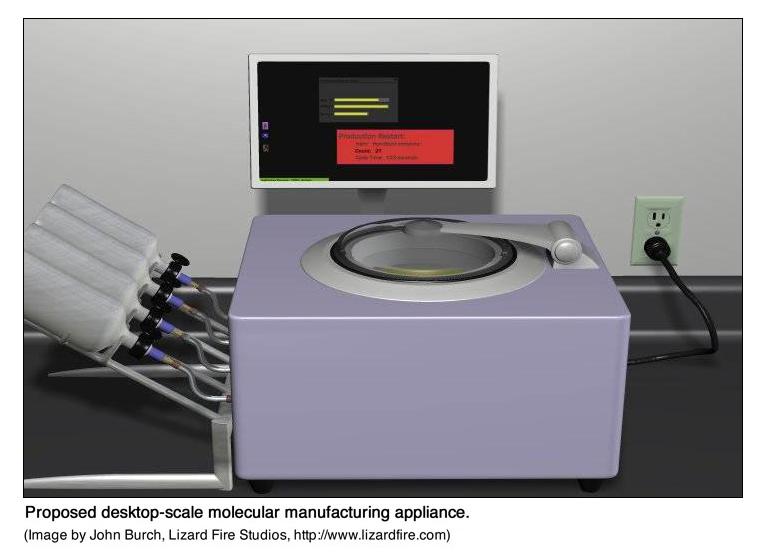
The power of nanotechnology can be encapsulated in an apparently simple device called a personal nanofactory that may sit on your countertop or desktop. Packed with miniature chemical processors, computing, and robotics, it will produce a wide-range of items quickly, cleanly, and inexpensively, building products directly from blueprints.

◄ Click to enlarge
Artist's Conception of a Personal Nanofactory

Courtesy of John Burch, Lizard Fire Studios (3D Animation, Game Development)

Exponential Proliferation

Nanotechnology not only will allow making many high-quality products at very low cost, but it will allow making new nanofactories at the same low cost and at the same rapid speed. This unique (outside of biology, that is) ability to reproduce its own means of production is why nanotech is said to be an exponential technology. It represents a manufacturing system that will be able to make more manufacturing systems—factories that can build factories—rapidly, cheaply, and cleanly. The means of production will be able to reproduce exponentially, so in just a few weeks a few nanofactories conceivably could become billions. It is a revolutionary, transformative, powerful, and potentially very dangerous—or beneficial—technology.

How soon will all this come about? Conservative estimates usually say 20 to 30 years from now, or even much later than that. However, CRN is concerned that it may occur sooner, quite possibly within the next decade. This is because of the rapid progress being made in enabling technologies, such as optics, nanolithography, mechanochemistry and 3D prototyping. If it does arrive that soon, we may not be adequately prepared, and the consequences could be severe.

We believe it's not too early to begin asking some tough questions and facing the issues:

bulletWho will own the technology?
bulletWill it be heavily restricted, or widely available?
bulletWhat will it do to the gap between rich and poor?
bulletHow can dangerous weapons be controlled, and perilous arms races be prevented?

Many of these questions were first raised over a decade ago, and have not yet been answered. If the questions are not answered with deliberation, answers will evolve independently and will take us by surprise; the surprise is likely to be unpleasant.

It is difficult to say for sure how soon this technology will mature, partly because it's possible (especially in countries that do not have open societies) that clandestine military or industrial development programs have been going on for years without our knowledge.

We cannot say with certainty that full-scale nanotechnology will not be developed with the next ten years, or even five years. It may take longer than that, but prudence—and possibly our survival—demands that we prepare now for the earliest plausible development scenario.

More Background on Nanotechnology:

bulletNanotechnology Basics - For students and other learners
bulletManaging Magic - A brief overview of the challenges posed by advanced nanotechnology
bulletNanotechnology on an Upward Slope - An online PowerPoint presentation
bullet Turn on the Nanotech High Beams - An essay published by Future Brief
bulletNano Simulation - A way to visualize what is meant by molecular manufacturing
bullet Debating the Future of Nanotechnology - Perspective from the Foresight Institute
bulletSafe Utilization of Advanced Nanotechnology - One of the founding papers of CRN
bullet5-Minute Nanosystems - A quick summary of Eric Drexler's foundational work on nanotechnology
bulletNanotechnology Press Kit - Compiled and published by Nanotechnology Now