There are several different types of fuel that can be produced, and the type of fuel depends on the type of reactor being used. To learn more about reactors, see Reactors. Pressurized water reactors use uranium dioxide as a fuel. Fast reactors use mixed oxide fuel containing uranium dioxide and plutonium dioxide. Thorium may also by used by some reactors. For more information about thorium, see New Types of Fuel.
Uranium Fuel
Uranium is the conventional nuclear fuel. Among all the radioactive elements, why was uranium chosen as the nuclear reactor fuel? There are several reasons. The safety, economy, availability, and water-cooled thermal reactors burning uranium fuel became the basis for the development of nuclear power in the world, thus uranium is widely used (1). Uranium dioxide is operationally safe and the technology has been perfected. Yet as reactor technology advances, new types of reactors allow for different types of fuel.
Uranium dioxide fuel in a light-water reactor is relatively inefficient compared to the potential utilization of natural uranium, but it has been used because it is safe and competitive with respect to power production from fossil fuels (1). Nuclear power can exist for a long time by using the concept of a closed fuel cycle with fast reactors (see Figure 1). A closed fuel cycle is one in which the used nuclear fuel is reprocessed and developed into fuel for reuse. The system becomes much more efficient and will extend the lifetime of nuclear fuel.
Figure 1: A Closed Nuclear Fuel Cycle

Image courtesy of Japan Nuclear
After low-enriched UF6 has been enriched, it must be processed into UO2 powder. The powder is then compressed into pellets and placed into Zircaloy (an aluminum-zirconium alloy) tubes, which is made into fuel rods. The Zircaloy canisters are shown in the figure below. The fuel rods are then bundled into a fuel assembly, shown in Figure 3.
Figure 2: Zirconium fuel rods

Figure 3: A Fuel Assembly

Mixed Oxide Fuel
Mixed oxide (MOX) fuel was developed as a means to reuse the plutonium that remained in spent nuclear reactor fuel. MOX also provides a means to burn weapons-grade plutonium to generate electricity. Currently, MOX is the new fuel used in about 2% of reactors around the world, and this proportion is expected to rise to 5% by 2010 (2).
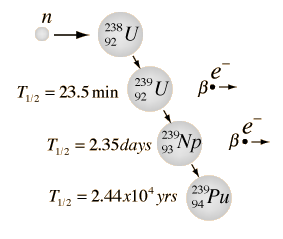
In all fission reactors, there is both fission of isotopes such as U-235, and there is also neutron capture by isotopes such as uranium-238. The neutron capture is demonstrated in Figure 4. The successive neutron capture of plutonium-239 will form plutonium-240, plutonium-241, and plutonium-242. Plutonium-239 and plutonium 241 are fissile like U-235, and some of it will burn in the reactor, giving off about 1/3 of the energy in a reactor in which the fuel is changed every three years. If a reactor has a higher “burn-up” more plutonium will be used. Approximately one percent of the spent nuclear fuel is plutonium. Two thirds of this remaining plutonium is fissile.
Figure 4: Production of plutonium 239 from uranium 238

Image courtesy of Hyperphysics
This leftover plutonium can be used again as nuclear fuel. However, it can also be used in nuclear weapons. To read more about the plutonium problem, see The Debate over Reprocessing. Although the half-life of plutonium-239 is long, Pu-238 and Pu-241 have shorter life-times that will decrease the fissile value of the plutonium over time. Due to the short lifetime of some isotopes, the plutonium should be reprocessed immediately. If the plutonium is recycled, 12%* more energy is derived from the uranium, and if the uranium is recycled as well, this percentage increases to 22 percent* (These numbers are based on a light water reactor with burn-up of 45 GWd/tU) (2).
How can the leftover plutonium and uranium be recycled? Please see Reprocessing.
Plutonium oxide is mixed with depleted uranium leftover at the enrichment plant, forming a new mixed oxide fuel (UO2+PuO2). MOX fuel consists of about 7-9% plutonium mixed with depleted uranium and is equivalent to uranium oxide fuel enriched to about 4.5% U-235, assuming that the plutonium has about two thirds fissile isotopes.** If weapons-grade plutonium is used (>90% Pu-239), only about 5% Pu would be needed in the mix.
** Reactors with higher burn-up will have a smaller percentage of fissile plutonium (2).
MOX reactors are already being used commercially in Europe. France and Japan have plans to increase their usage of MOX fuel by 2010. Many reactors use up to one-third MOX fuel. Although MOX fuel can be used in several different types of reactors, the plant must be adapted for the MOX fuel. More control rods are required in the nuclear reactor.
MOX fuel has several advantages. The fissile concentration of the fuel can be increased by simply adding more plutonium, which is much cheaper than enriching uranium. As the price of uranium itself goes up, MOX fuel will become more attractive economically. Also, by using MOX fuel, one is burning left-over plutonium that could have been used for nuclear weaponry.
MOX fuel can be compared to plutonium-thorium fuel. For more information, see New Types of Fuel.
Figure 5: MOX Fuel Production


 Photo: Lockheed Martin
 Another military industrial leader, Raytheon just awarded Cyclone Power Technologies a contract to develop its external combustion engine. The Cyclone Engine is akin to a portable steam turbine plant that offers huge efficiencies by capturing and reusing heat and running on renewable biofuels. The contract will give the company capitol to develop several applications of the technology including household versions of the engine.
Production consists of bringing the hydrocarbons contained in the substratum to the surface. This requires the use of a large number of wells. A field spreads over a vast area, at least several km² and sometimes more than 100 km². A traditional well (vertical or slightly deviated) only draws oil or gas from a radius of a few tens of metres. Moreover, such wells only cross the reservoir over the limited height of a vertical or near vertical cross section. A large number of vertical wells would therefore be necessary to completely extract the contents of a reservoir. The horizontal well technique has totally revolutionised the industry, because such wells have a much greater length of contact with the reservoir. Thus, the technique enables a significant reduction in the number of wells necessary for a given development. Production drilling presents a number of challenges. What is the principle of extraction?The basic principle is to generate pressure at the bottom of oil or gas wells, inferior to the pressure in the reservoir. As a consequence of this pressure difference, the hydrocarbons will move towards the well and thence to the surface. In practical terms, the well is totally lined with tubing right down to the reservoir. This tubing, difficult to move once it is fixed into position, guarantees the operational effectiveness of the well throughout its working life. The oil and gas are brought to the surface via another tube, in oil field jargon the (extraction) tubing, placed in the lining. This tubing is detachable and can be changed whenever corrosion or deposition problems appear. Sometimes, the oil field pressure is sufficient for the hydrocarbons to make their own way to the surface; in this case the well is said to be “eruptive”. In other cases wells are never eruptive. And in all cases, the oil field pressure diminishes gradually as production continues. After a certain time, it is no longer sufficient for eruptive extraction and it becomes necessary to stimulate production, what is called assisted recovery. On arrival at the surface, the output from the extraction wells begins its journey through the surface installations. | |||||||
|


Lets admit it, who doesn't dream of having their very own robotic minion? I would achieve instant nirvana if someone is catering to my every need and taking care of all the mind-numbing household chores. Well folks robots may just be the future and lets all prey that one day we mere mortals can also afford them. Here are some of the best robots that will get the job done while you lounge around and do nothing!
Unless you are a budding Julia Child, chances are you detest cooking with a passion. Wouldn't it be great if you have your own little robot that does the needful? The HOAP-3claims to make a killer robot and we believe him from the video below.


The Muiro is a robotic speaker on wheels, which means you have your own musical stalker. Miuro can connect your 802.11b/g wireless network to stream music and costs around 1000 bucks.

Don't fight over the remote with your partner and relinquish control to the FujitsoMaron-1 Robot. This little bugger can control your home appliances and entertainment system.

"Hello, my name is Wakamaru and I am at your service 24/7." Magical words aren't they? Designed by Mitsubishi Heavy Industries, Wakamaru acts like a caretaker for the elderly and performs tasks, which require a lot of mobility.


Spy, the twenty first century style! Meet Spykee, from Meccano, which talks, walks, chats on the phone and even takes snapshots. The robot has a WiFi card, so that you can control it remotely on the net.


The Spykee Vox is a must have all audiophiles as the robot plays your iPod tunes, listens to voice commands and includes three microphones, a remote, USB plug, stereo loudspeakers, IR sensors and some killer moves.

Statutory Warning: Don't try this at home! The Forest Fire Prevention Robot by Jordan Guelde is mean, lean forest machine. It clears up areas of foliage so that forest fires don't spread. Governor Schwarzenegger aka the Terminator may just approve?

Legos are awesome. We love Legos. You know what we love more? Robots made from Legos! Check out the Lego Bartender Robot that pours you a strong one, in its own cool style.


The "Violin-Playing Robot" by Toyota will soothe those nerves. Who doesn't like musical prodigy at their disposable? Apart from playing the violin, it is also capable of performing a variety of tasks with its hands and arms.

No matter what your poison is the MotoMan RoboBar is equipped to satiate your alcoholic cravings. As a bartender not only is it lightening fast but also cheaper in the longer run.
.jpg)


.jpg)